Volunteering trajectories across crises
With this study published in Social Forces, Lærke Høgenhaven, Louis Møgelmose, Hjalmar Bang Carlsen, and Jonas Toubøl document substantial changes in the composition of civil society’s volunteer population from before to after COVID-19 and show that pandemic crisis volunteers are likely to also volunteer in subsequent crises. These findings challenge the notion that crisis volunteering is spontaneous and emergent and suggest that informally organised crisis volunteers can play a crucial role in preparing for future crises.
By analyzing the little studied relationship between crisis volunteering (addressing societal crises) and ordinary volunteering (unrelated to crises), the study examines the resilience of ordinary volunteering during crises, possible spill-over between ordinary and crisis volunteering, and the persistence of individual crisis volunteers across the COVID-19 pandemic in 2020–2022 and the reception of Ukrainian refugees fleeing Russia’s invasion in 2022.
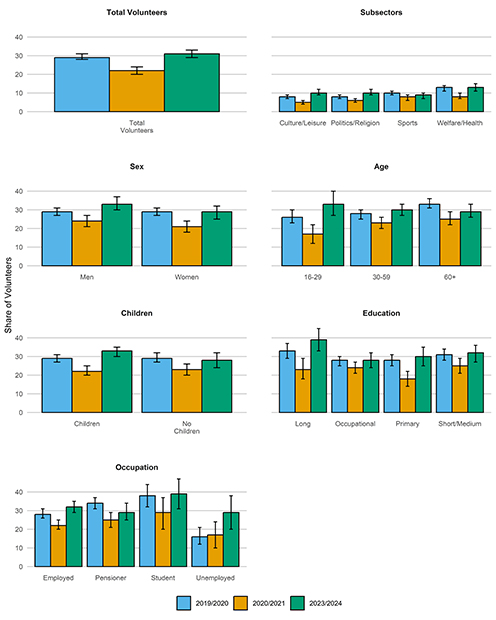
The results show that ordinary volunteering was highly resilient to the pandemic despite a significant reduction during the crisis. However, after the lifting of COVID-19 restrictions, civil society bounced back to its pre-crisis level of volunteering. However, there was a substantial replacement with new cohorts of volunteers being recruited: young people and people outside the labour market make up a significantly larger proportion of the volunteer population after COVID-19, compared to before, suggesting both a generational change as well as socioeconomic transformation of voluntary civil society. These findings are based on analysis of three cross-sectional surveys of the Danish adults carried out before COVID-19 in 2020, during 2021 and after the pandemic in 2024.
Furthermore, by tracking 694 persons across the crises from 2020 to 2024, Høgenhaven and colleagues show that, while participating in ordinary volunteering before the crisis predicted mobilising for crisis volunteering, this was not the case the other way around: crisis volunteering did not spill over into ordinary volunteering after the pandemic. Rather, crisis volunteers persisted in engaging in crisis volunteering when the Ukrainian refugees arrived.
These findings have important implications for civil society studies because the absence of spill-over between ordinary and crisis volunteering suggests that the two types of volunteering operate according to distinct logics. Furthermore, the persistence of crisis volunteers across crisis challenges notions of crisis volunteering being spontaneous and emergent.